The International Dark Sky Discovery Center (IDSDC) in Fountain Hills, Arizona, is visionary in its ideas, planning, and execution. The center seeks to enthusiastically offer a one-of-a-kind experience to the Greater Phoenix area as a science center and observatory equally dedicated to education as it is to preservation. The idea for the IDSDC began in 2019, born from a passionate community of astronomers and non-astronomers alike. The IDSDC built up momentum, becoming a non-profit organization in 2020 with ambitious visions of what it would look like and eventually become.
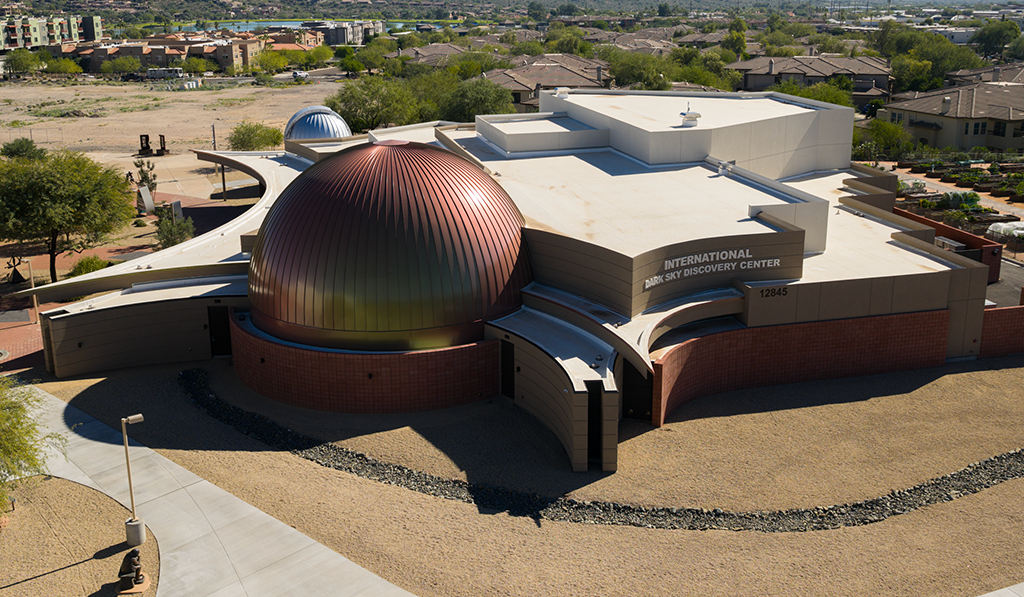
Preliminary designs for the International Dark Sky Discovery Center always featured two distinct domes—a dome to house the observatory’s telescope, which is the largest in the Greater Phoenix area, and a dome over the building’s hyperspace planetarium. The planetarium dome is the largest dome on the structure, sitting atop a theater with cutting-edge projection technology that projects images of the solar system in immersive detail. With curved rows and 3D capabilities, the hyperspace planetarium envelops audiences in outer space, able to journey throughout it and experience the solar system beyond what we can see on Earth. But it won’t only project solar images, it’ll be capable of a range of projections, from underwater explorations to human anatomy and more. Originally called the Hyperspace Planetarium in development plans because of its ability to hyper-realistically transport the audience into the solar system and other environments, the planetarium is recognized as the Craig and Ruth Gimbel Planetarium in honor of a significant seven-figure contribution the pair made when the discovery center was a mere concept on paper. For the project to evolve, the International Dark Sky Discovery Center has relied on the generosity and enthusiasm of its community.
Facilitating the project’s creation is the passion of a local and global community. The project’s location, Fountain Hills, AZ, is instrumental to the center’s purpose. In 2018, Fountain Hills earned status as an International Dark Sky Community, the world’s 17th. The title is given by DarkSky International, a nonprofit organization dedicated to nocturnal conservation and reducing light pollution. DarkSky certifies locations through its International Dark Sky Places (IDSP) program, a certification given to areas that align themselves with DarkSky’s mission of preserving and protecting natural night skies through education and legislation. The IDSDC’s mission and values mirror the efforts of DarkSky and honor its city’s DarkSky status.
“Educating people about the wonders of the night sky and the importance of preserving dark skies is a goal we share with the International Dark Sky Discovery Center,” says Ruskin Hartley, the Executive Director of DarkSky International, as shared on the IDSDC’s website.
The efforts of the center extend beyond astronomy interests, equally attentive to the interconnectedness of the universe and how it impacts the well-being of animals, plants, and humans. The hybrid focus of ecological preservation and astronomy, including a telescope to witness the cosmos, makes IDSDC a one-of-a-kind facility globally, a fact proudly shared on the IDSDC website.
The IDSDC is equally committed to educating and inspiring future generations of scientists with four pillars to help them achieve their mission: education, research, dark sky preservation, and astrotourism. The center’s design considered these main focuses when planning its experiences and designing a structure that would accommodate all the elements each experience would include. In an effort to achieve its mission, the center lauds several attractions such as the Dark Sky Observatory, the Craig and Ruth Gimbel Planetarium, an Inspiration Theater, Night Sky Exhibit Hall, and the Einstein Exploration Station. Across the attractions are interactive, creative, and luminary science-based educational experiences that seek to foster the minds of the future from enthusiasts, K-12 students, undergrad and post-grad scholars, and tourists. With such a variety of attractions to enjoy at the IDSDC, the exterior necessitated a design to be aesthetically pleasing and modern, yet functional for all the attractions’ needs.
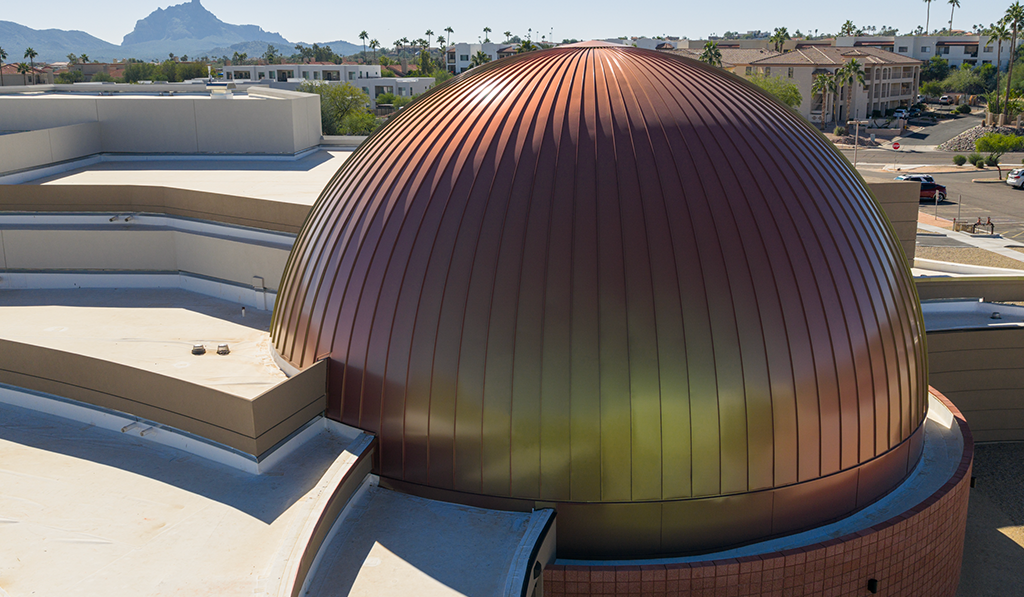
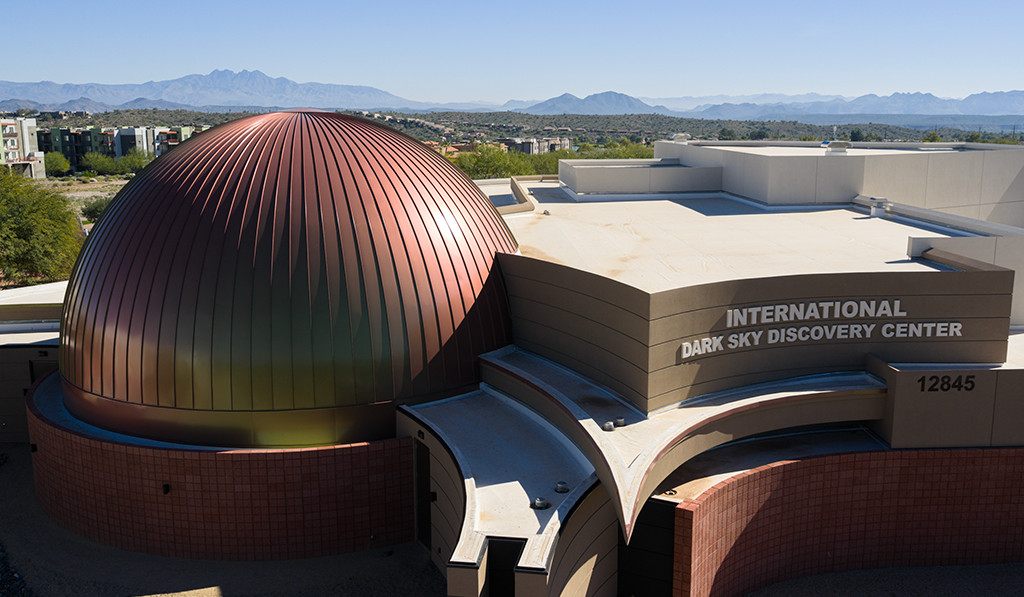
Peeking out from the building’s silhouette are the two distinct domes of the observatory and planetarium, becoming so iconic to the structure that they’ve become identifying features of the facility as part of the IDSDC logo. The larger dome of the structure is the Craig and Ruth Gimbel Planetarium dome, a robust dome that serves as an accent of the building. It protrudes over the center’s parapet roofs as an attention-grabber and statement maker, slightly nestled into the horizontal datum of the roofscape. An architectural accent of this stature required capable yet striking metal panels to do the envisioned design justice.
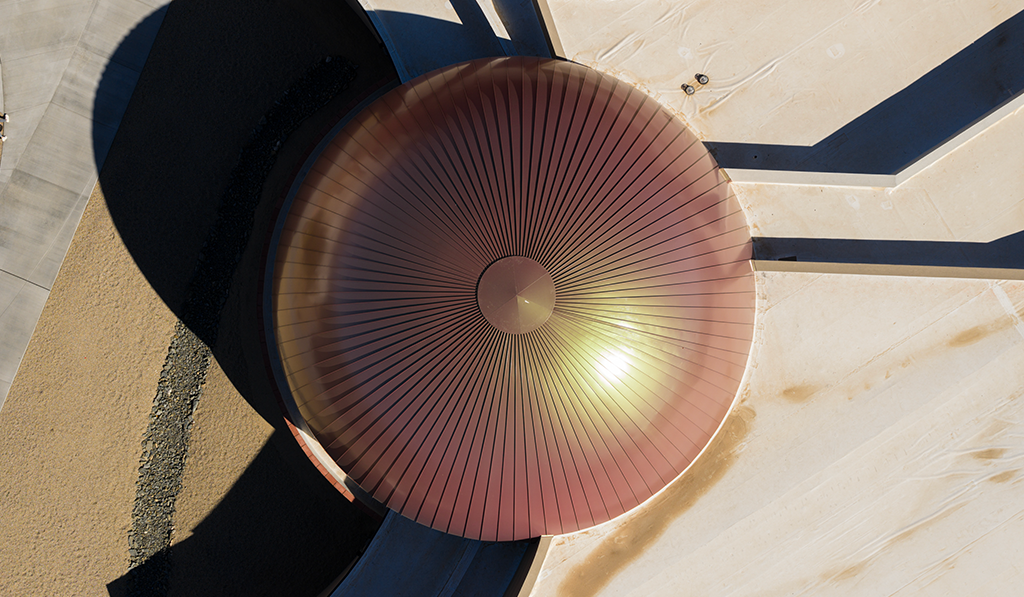
The planetarium dome is 39 feet in diameter and tilted forward 20 degrees, and the tilt is integral to the desired projection experience of hyper-realistic space viewing of our solar system. The dome was constructed off-site, brought to the location, and then lifted on a 500-ton crane for the installation. The exterior metal panels adorning the planetarium dome required meticulous fabrication to ensure proper fit. Comprising the exterior finish of the roof’s dome are custom curved .040 aluminum ATAS panels in a custom color named Kameleon Rose Dust. Specific dimensions accounting for unique panel widths and curves, with special lengths to accommodate the tilt, made the project highly complex to fabricate and install, requiring precise coordination between the dome’s geometry and the ATAS panels. It likewise required excellent communication across the architect, contractor, distributor, and manufacturer. Collaborative effort and expertise from all partners involved in the project resulted in the gleaming planetarium dome. ATAS provided technical guidance and quality oversight for the dome, working closely with Global Roofing’s installation team and McCarthy Building Companies’ quality-control team to help ensure the panels met the project’s needs. Together, the completion of the dome and achievement of desired aesthetics were possible.
The dome’s peak is the highest part of the structure, closest to the sun and catching a lot of natural sunlight. Unique about the dome’s shape is that it reflects light in different directions. Adding to the grandiosity of the structure is how the natural environment interacts with the custom-colored ATAS panels; sunlight and time of day seemingly changing the color of the panels, living up to the chameleon allusion in the custom color’s name. The panels appear most of the time to be colored copper or rose gold, an Arizona desert-inspired color. However, the longer you look at them, and as the position of the sun changes overhead, nebula-like iridescent shades emerge, drawing out hues of purple and green. The panels even have a sheen that glitters faintly like stars in the sky depending on how light reflects. A good panel system meets the basic needs of a project, but truly exceptional panel systems contribute to an overall vision and philosophy of a structure—much like the details of the dome that mimic elements of outer space, exactly what visitors of the center will come to interact with.
The architectural choices, craftsmanship, and stellar application of the panels have earned the IDSDC an ATAS Project of the Year Award as an outstanding project. The project won first place in the accents category for its innovative and refined use of curved metal panels. The IDSDC is not yet open to the public but continues to make great strides towards its goal of opening in early 2027. All crews involved with the development of the dome deserve recognition: designing the project is SWABACK Architects + Planners, the general contractor is McCarthy Building Companies, and the planetarium dome installer was Global Roofing. Through close collaboration and careful attention to detail, the result of the dome is a finished installation that successfully contributes to the visionary design and purpose of the International Dark Sky Discovery Center. The planetarium dome is set, much like a sun rising on the horizon, as a symbol of a bright future for a new global cultural landmark in Arizona.
Learn more about the International Dark Sky Discovery Center.
Explore the history of the International Dark Sky Discovery Center with their updates.